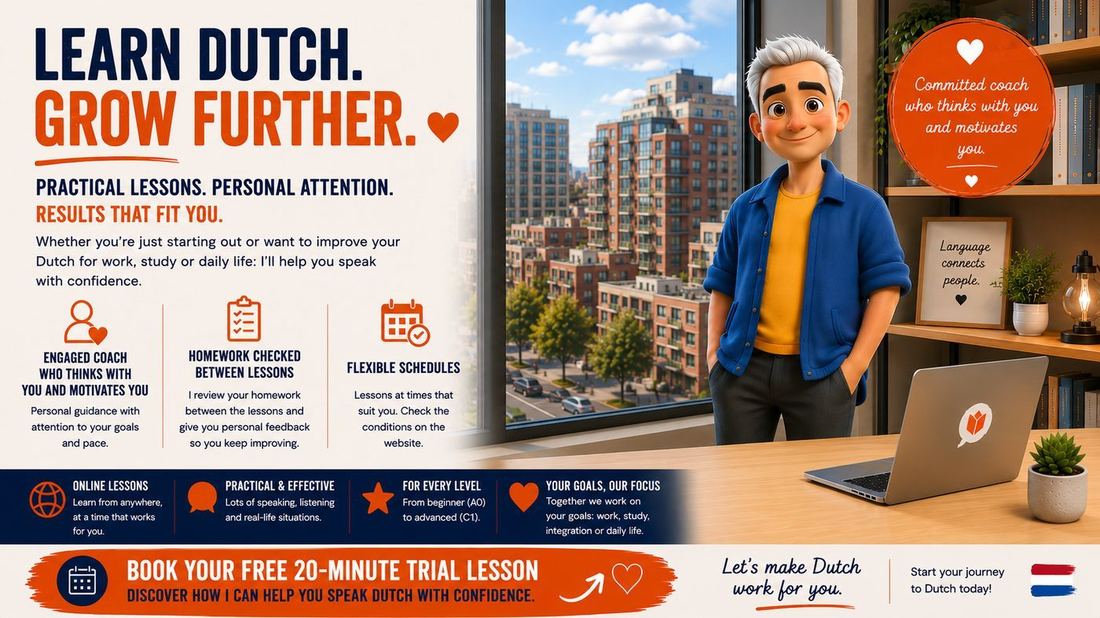
Watch a real Dutch video below, learn the key phrases, and try eight short exercises. In your personal lessons, we'll practise everyday situations just like this one.
A short, natural exchange at a train station kiosk — polite, everyday Dutch you'll use constantly as a beginner.
From the video and the exercises below — these come up constantly when shopping or asking for directions.
Dutch on the left, English on the right — read it once before watching, then again while you listen.
Click a Dutch word, then click its English translation. Matched pairs turn green.
Click a Dutch word, then click its English translation.
Click a Dutch word, then click its English translation.
There are several ways to order food and drinks in Dutch — from most to least formal.
The most polite and common way to order something.
Friendly and commonly used.
You'll often hear this in cafés, snack bars, or among friends.
A short and natural way to order.
💡 Language tip: Both alstublieft and alsjeblieft mean "please."
Alstublieft = formal — use it in formal situations, or with people you want to address politely and create some distance with, e.g. customer service, officials, or someone you've just met.
Alsjeblieft = informal — use it with friends, family, children, people you know well, and in most everyday social situations (shops, cafés, etc.).
Click an answer for each question — you'll see right away if you got it right.
1. How do you politely order a bottle of water?
2. The shop assistant says: "Dat is €2,50." What do you say next?
3. How do you ask where the platforms are?
4. What does "Graag gedaan!" mean?
5. Which sentence is correct?
Click the words in the right order to build each sentence. Click a word again to remove it.
1. "Can I have a bottle of water, please?"
2. "Where are the platforms?"
3. "I would like a coffee."
The video ends with directions to the platforms — these words come up constantly when asking for directions.
Complete each sentence from the transcript — click the missing word.
1. "Dat _______ €2,50."
2. "Mag ik u nog iets _______?"
3. "_______ zijn de perrons?"
4. "Rechtdoor en neem de _______ naar boven."
Got all the answers right?
A video can teach you the words — only a real conversation teaches you to actually use them. Practice this exact dialogue live, with feedback on your pronunciation.
Practice this dialogue with Tim →Textbooks rarely teach the small, practical exchanges you actually need on day one — ordering, greeting, paying, asking for directions.
Lessons use short, natural exchanges like this one — the kind you'll actually need from your very first week in the Netherlands.
New words are introduced in context, then reinforced with speaking practice — so they're easier to recall when you need them.
Lessons fit around your schedule. Free rescheduling up to 12 hours in advance.
Personal feedback on your own pronunciation, correction the moment you make a mistake, real grammar explanations, and a learning plan built around you — not a script.
💡 Not sure where to start? Take the free level test, or read more about our lessons.
This video is A1 level — perfect for complete beginners, but the lessons behind it work for any stage of learning Dutch.
Not sure of your level yet? Take the free level test, or read more about our lessons.
Practical, personal, and grounded in Dutch you'll actually need — not just textbook dialogues.
We use short video clips like this one to train your ear, then immediately practise speaking the same patterns yourself.
New words are introduced through real situations, not word lists — so they're easier to recall when a similar moment comes up.
Grammar and writing are practised at home, with detailed feedback — so lesson time goes to speaking.
We bring in the vocabulary and situations from your actual life — shopping, travel, appointments — not generic examples.
After a short intake we determine your level and the pace that fits your goals — with concrete milestones along the way.
Real reviews from Preply and private students.
"Tim makes every lesson practical and relevant — we work on exactly the situations I run into during my week. I feel so much more confident now."
"Patient, clear, and always well-prepared. I went from barely speaking to holding real conversations."
"Tim's lessons are built around real life, not just grammar rules — that made all the difference for me as a beginner."
🏅 Top 5% Dutch Tutors on Preply
View all reviews on Preply →Book your free trial lesson and let's build on moments exactly like this one.
Start with a free 20-minute lesson — we discuss your level and goals.
Book free trial lesson →Questions about lessons or your level? Send an email — I usually reply within a few hours.
Email Tim →