Choose the correct plural
20 words. Choose the correct plural form each time: -s, -'s or -en.
Test how much you already know about -s, -'s and -en — mixed together, just like in real life.
Free online exercises for beginners. No account needed — start right away. Pick your language for the instructions; the exercises themselves are in Dutch, because that's how you learn best.
🎓 Want to keep practising plurals? Book a trial lesson with Tim.
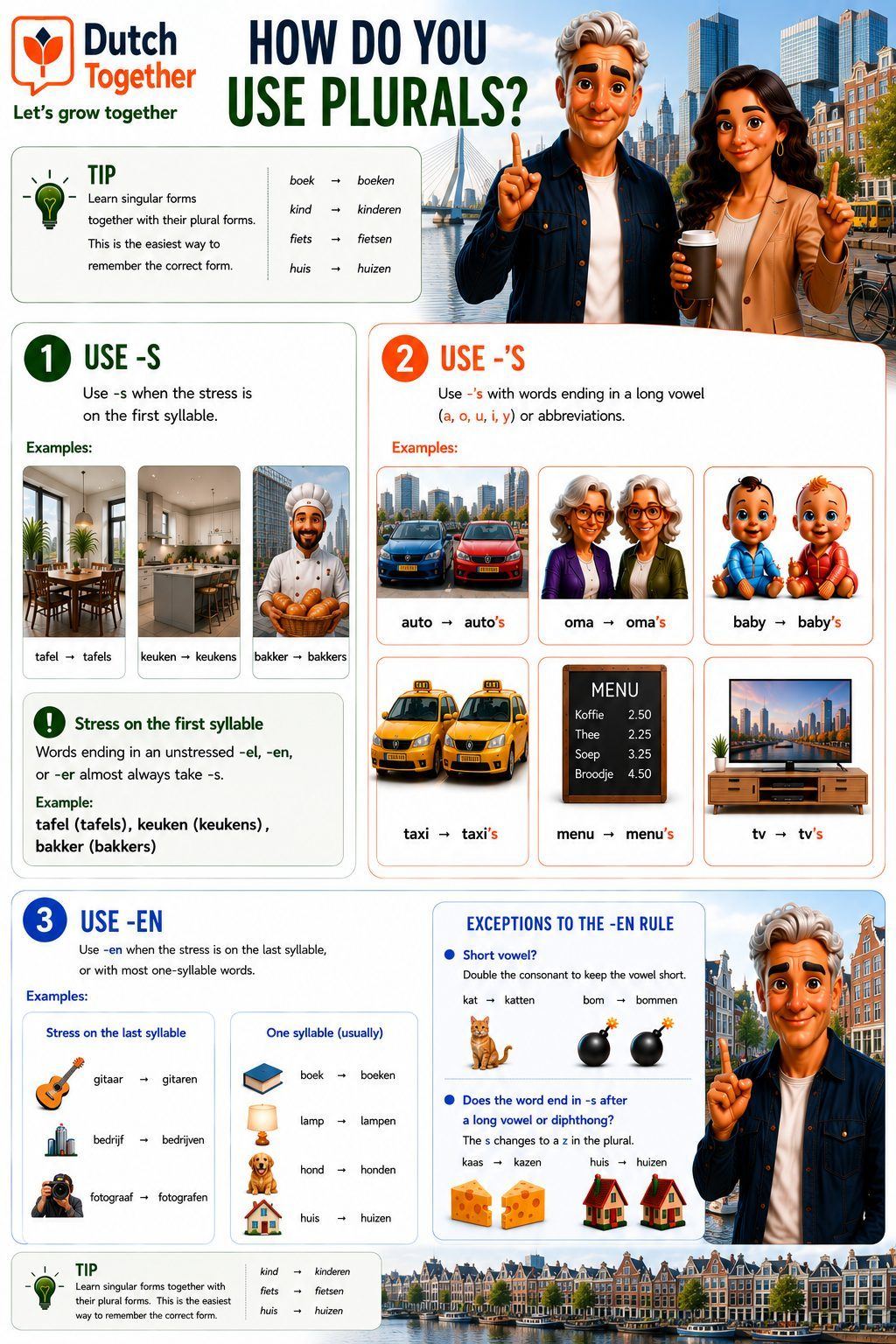
Book free trial lesson →Dutch nouns usually take -s, -'s or -en in the plural. Which ending you use depends on the stress and the final sound of the word.
Tip: always learn the singular form together with its plural — that's the easiest way to remember the right form.
You use -s when the stress falls on the first syllable. Words ending in an unstressed -el, -en or -er almost always take -s.
You use -'s with words ending in a long vowel (a, o, u, i or y), or with abbreviations.
You get -en in the plural when the stress falls on the last syllable, or with most one-syllable words.
Watch out with a short vowel: the consonant doubles to keep the sound short. And if the word ends in -s after a long vowel or diphthong, the s becomes a z.
20 words. Choose the correct plural form each time: -s, -'s or -en.
Test how much you already know about -s, -'s and -en — mixed together, just like in real life.
Real reviews from Preply and private students.
"After several attempts with other teachers, Tim was the one who truly gave me the confidence to speak Dutch. Thanks to his patience I passed all my integration exams on the first try — with maximum scores."
"Tim prepares every lesson carefully and draws up a personal schedule. Everything is always well organised — he is friendly and professional at the same time."
"After only three lessons I already feel a big difference. I am now convinced that I will reach a professional level in Dutch this year."
🏅 Top 5% Dutch Tutors on Preply
View all reviews on Preply →💡 The plural is just one piece of the puzzle. For a broader overview — including how a noun's gender (de/het) ties into its plural form, plus diminutives — take a look at a complete guide to Dutch nouns, a guide I wrote for the Preply Blog.
📚 More grammar practice?
Practising is a great start. With personal lessons you progress faster.
Meet Tim in a free 20-minute lesson — no obligations.
Book free trial lesson →Individual, children or corporate — find the package that suits you.
View pricing →