When does a Dutch adjective get -e, and when not? Two simple rules make it much easier. Free explanation + 25 practice questions.
Want to practise Dutch with a teacher?
Book a free trial lesson →Dutch adjectives (like mooi, groot, slim) sometimes change form. The key rule: with de-words in the indefinite form (een), the adjective gets -e, but with het-words in the indefinite form it does not. In every other case — definite form, plural, possessives and demonstratives — it almost always gets -e.
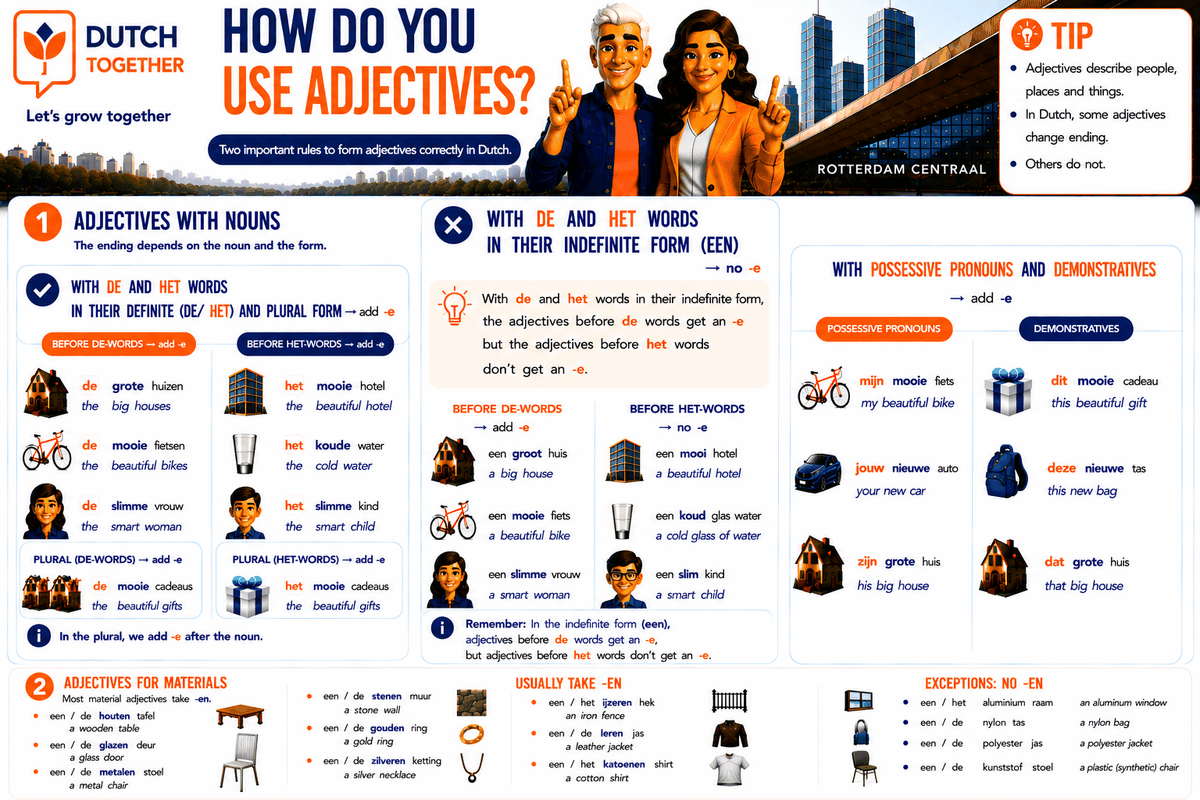
Materials follow their own rule: most take -en. Think of hout (wood) → houten, glas (glass) → glazen, metaal (metal) → metalen, goud (gold) → gouden, zilver (silver) → zilveren, leer (leather) → leren and katoen (cotton) → katoenen.
A few materials — usually more modern or borrowed words — don't follow this rule: aluminium, nylon, polyester and kunststof (plastic) stay unchanged.
Choose the correct form each time. You'll get a short explanation right after each answer.
A personal Dutch lesson helps you use grammar naturally in real conversation — not just in exercises.
Book a free trial lesson →No fixed group classes — everything is tailored to your level and goal.
Exercises and explanations that match what you actually need.
Lots of speaking time, because grammar only sticks when you actually use it.
Rules like this -e rule, explained step by step, without jargon.
From complete beginner to advanced — A0 to C1.
Focused practice for civic integration, KNM or CNaVT where relevant.
Real reviews from Preply and private students.
"Tim explains grammar rules step by step, without unnecessary jargon. I finally understand when an adjective gets -e or not."
"The lessons are well structured and always matched to my level. Grammar that seemed confusing at first now makes sense."
"Practical and clear — exactly what I needed to speak Dutch more confidently."
🏅 Top 5% Dutch Tutors on Preply
See all reviews on Preply →📚 More grammar practice?
Start with a trial lesson and see how personalised Dutch lessons can help you make progress.
Get to know Tim in a free 20-minute lesson — no obligation.
Book a free trial lesson →