Regular verbs and 't kofschip
With regular verbs, the verb stem doesn't change in a special way. You use fixed rules to form the simple past and the past participle.
The simple past
To form the simple past of a regular verb, you look at the last letter of the stem.
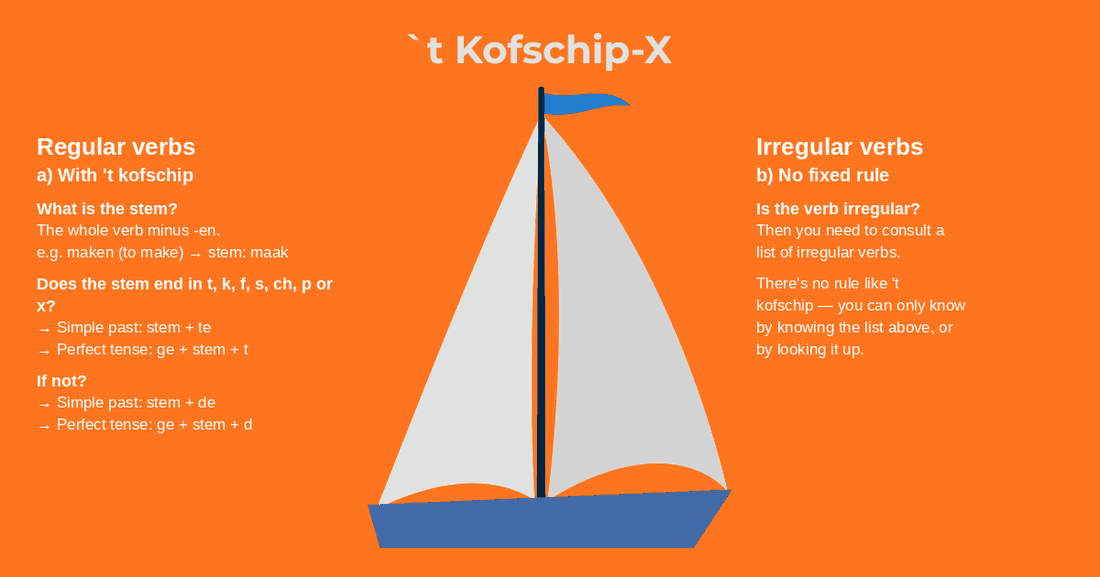
You can use 't kofschip-X for this. The letters are:
t – k – f – s – ch – p – x
Is the last letter of the stem in 't kofschip-X? Then you use -te(n) in the simple past.
Is the last letter not in 't kofschip-X? Then you use -de(n).
Examples
werken (to work) → werk
The stem ends in k. The k is in 't kofschip-X.
→ ik werkte
→ wij werkten
maken (to make) → maak
The stem ends in k.
→ ik maakte
→ wij maakten
reizen (to travel) → reiz
The stem ends in z. The z is not in 't kofschip-X.
→ ik reisde
→ wij reisden
bellen (to call) → bel
The stem ends in l. The l is not in 't kofschip-X.
→ ik belde
→ wij belden
The past participle
You can also use 't kofschip-X for the past participle.
Is the last letter of the stem in 't kofschip-X? Then the past participle ends in -t.
Is the last letter not in it? Then it ends in -d.
Examples
werken → gewerkt
The stem ends in k → -t
maken → gemaakt
The stem ends in k → -t
bellen → gebeld
The stem ends in l → -d
reizen → gereisd
The stem ends in z → -d
⚠️ Watch out! For verbs whose stem ends in v or z, you need to look carefully at the original verb. For example: reizen → reiz → gereisd — although the stem reiz ends in z, the z is not in 't kofschip-X. That's why you write gereisd with a d. Also leven → lev → geleefd: the v is not in 't kofschip-X, so you write geleefd with a d.
Quick summary
't kofschip-X → -te(n) and -t | Not in 't kofschip-X → -de(n) and -d
| Verb |
Stem |
Simple past |
Past participle |
| werken | werk | werkte | gewerkt |
| maken | maak | maakte | gemaakt |
| bellen | bel | belde | gebeld |
| reizen | reiz | reisde | gereisd |
| leven | lev | leefde | geleefd |
Remember: for regular verbs, look at the last letter of the stem, then use 't kofschip-X to determine whether you use -t or -d.
The 50 most important irregular verbs
These verbs don't follow the regular -te/-de pattern in the simple past, and not the regular t/d ending in the perfect tense either. Learn them well — they come up everywhere, including in the perfect tense below.
| Infinitive |
Simple past (I) |
Perfect tense |
Meaning |
| zijn | was | is geweest | to be |
| hebben | had | heeft gehad | to have |
| worden | werd | is geworden | to become |
| gaan | ging | is gegaan | to go |
| komen | kwam | is gekomen | to come |
| doen | deed | heeft gedaan | to do |
| zien | zag | heeft gezien | to see |
| geven | gaf | heeft gegeven | to give |
| nemen | nam | heeft genomen | to take |
| weten | wist | heeft geweten | to know |
| kopen | kocht | heeft gekocht | to buy |
| brengen | bracht | heeft gebracht | to bring |
| denken | dacht | heeft gedacht | to think |
| zoeken | zocht | heeft gezocht | to search |
| eten | at | heeft gegeten | to eat |
| drinken | dronk | heeft gedronken | to drink |
| lopen | liep | heeft/is gelopen | to walk |
| rijden | reed | heeft/is gereden | to drive |
| vinden | vond | heeft gevonden | to find |
| spreken | sprak | heeft gesproken | to speak |
| schrijven | schreef | heeft geschreven | to write |
| beginnen | begon | is begonnen | to begin |
| blijven | bleef | is gebleven | to stay |
| vergeten | vergat | is vergeten | to forget |
| lezen | las | heeft gelezen | to read |
| slapen | sliep | heeft geslapen | to sleep |
| staan | stond | heeft gestaan | to stand |
| zitten | zat | heeft gezeten | to sit |
| liggen | lag | heeft gelegen | to lie |
| helpen | hielp | heeft geholpen | to help |
| vragen | vroeg | heeft gevraagd | to ask |
| dragen | droeg | heeft gedragen | to carry/wear |
| vallen | viel | is gevallen | to fall |
| breken | brak | heeft gebroken | to break |
| kiezen | koos | heeft gekozen | to choose |
| kijken | keek | heeft gekeken | to look |
| krijgen | kreeg | heeft gekregen | to get/receive |
| lijken | leek | heeft geleken | to seem |
| moeten | moest | heeft gemoeten | must |
| mogen | mocht | heeft gemogen | may |
| sluiten | sloot | heeft gesloten | to close |
| springen | sprong | is gesprongen | to jump |
| trekken | trok | heeft getrokken | to pull |
| verliezen | verloor | heeft verloren | to lose |
| vertrekken | vertrok | is vertrokken | to depart |
| vliegen | vloog | heeft/is gevlogen | to fly |
| willen | wilde | heeft gewild | to want |
| winnen | won | heeft gewonnen | to win |
| zwemmen | zwom | heeft/is gezwommen | to swim |
| zingen | zong | heeft gezongen | to sing |
When do you use the simple past, and when the perfect tense?
Both forms describe something in the past, but for a different purpose.
🔁
Simple past — habits and stories
Use the simple past for habits or routines in the past, or for something that was in progress at a certain moment.
Ik werkte ("I worked") describes both a habit and being in progress (compare: ik was aan het werken, "I was working").
Also useful as background or context in a longer story — the simple past keeps the narrative "moving along".
🔗 Quizlet flashcards for the simple past →
✅
Perfect tense — result, recent action, or not (yet) done
Use the perfect tense for a) something you did in the past, or something that happened — with the emphasis on the result, not on how it unfolded.
Ik heb gewerkt ("I have worked") says: it's done, the result counts.
b) for something you have just done — Ik heb net gegeten ("I've just eaten").
c) for something you have never done, or haven't done yet — Ik heb nog nooit sushi gegeten ("I've never eaten sushi").
🔗 Quizlet flashcards for the perfect tense →
💡 Note for English speakers: Dutch uses the VTT much more freely than English uses the present perfect. In English, once you mention a specific time in the past (yesterday, last week), you must switch to simple past — "I ate sushi yesterday", not "I have eaten sushi yesterday". In Dutch, the VTT works perfectly fine together with a specific time reference — Ik heb gisteren sushi gegeten is completely normal, especially in spoken Dutch. Don't assume "VTT = present perfect" one-to-one; often the natural English translation is simple past.
Zijn or hebben in the perfect tense?
The perfect tense always needs an auxiliary verb: zijn ("to be") or hebben ("to have"). Which one you use depends on the main verb.
🚶
Zijn
Use zijn with verbs that describe movement (with a clear start or end point) or a change of state.
For example: gaan, komen, vertrekken, beginnen, worden, vallen, blijven
✋
Hebben
Use hebben with most other verbs — especially verbs that don't describe movement or a change of state.
For example: kopen, geven, zien, schrijven, eten, helpen
💡 Watch out for the exception: verbs like lopen, rijden, zwemmen and trekken can take either. Is there a clear direction or destination (somewhere you're heading to)? Then use zijn — "Ik ben naar het park gelopen" ("I walked to the park"). Are you just describing the activity itself, with no destination? Then use hebben — "Ik heb een uur gelopen" ("I walked for an hour").
Exercise 1
Simple past — Around the neighbourhood A2/B1
Choose the correct simple past form. Pay close attention to the context of the sentence.
🔗 Want more practice? Check out my free Quizlet flashcards for the simple past.
Your score: 0/10
Exercise 2
Simple past — At work A2
Choose the correct simple past form. Pay close attention to the context of the sentence.
Your score: 0/10
Exercise 4
Perfect tense — At work B2
Choose the correct auxiliary verb + past participle together.
Your score: 0/10